What Are the Top Betonway Products for Global Buyers?
Global buyers are rethinking concrete equipment through productivity, durability, energy use, and after-sales support. This shift gives Betonway a relevant position in a demanding market. According to the International Energy Agency, cement production creates roughly 7% of global energy-related CO2 emissions. Equipment efficiency now matters beyond purchase price.
This article examines Betonway products that may suit contractors, ready-mix suppliers, and infrastructure developers. The review focuses on batching plants, concrete mixers, pumps, automation systems, and replacement components. Buyers need more than impressive specifications. They need stable output beside a dusty jobsite, accurate weighing during long shifts, and parts that arrive before a project stops.
Practical evidence matters.
The Global Cement and Concrete Association’s 2050 Roadmap highlights efficiency, digitalisation, and lower-carbon production as major industry priorities. These priorities shape how global purchasers compare Betonway solutions. Product capacity, maintenance access, control accuracy, power consumption, and local technical support deserve equal attention. However, published figures do not always reflect field conditions. Climate, aggregate moisture, operator training, transport distance, and grid stability can change real performance.
A responsible comparison must therefore separate verified data from marketing claims. It should also consider regional certifications, warranty terms, installation support, and spare-parts availability. These details often decide whether equipment performs smoothly or becomes an expensive bottleneck. The following outline explores the strongest Betonway product options, their practical advantages, and the limitations buyers should question before ordering. No product is perfect. That is worth admitting.
Betonway’s Product Range and Global Buyer Requirements
Global buyers usually compare concrete equipment by project conditions, not catalogue size. A practical range includes stationary and mobile batching plants, planetary or twin-shaft mixers, concrete pumps, aggregate bins, silos, and control systems. Mobile plants suit remote roads and short projects. Stationary plants offer higher output and steadier quality for urban construction. According to the Global Cement and Concrete Association, the world uses about 14 billion cubic metres of concrete each year. That scale makes uptime, batching accuracy, and spare-parts access commercial priorities.
Buyer requirements vary sharply across regions. A contractor in a humid coastal area may need corrosion-resistant frames and sealed electrical cabinets. A desert project may require dust protection, water recycling, and reliable cooling. The United Nations projects that 68% of people will live in urban areas by 2050, increasing demand for compact plants near crowded construction zones. Equipment should also match local power supply, aggregate size, transport limits, and recognized safety standards. Documentation matters.
It is easy to overvalue maximum capacity. Not every buyer needs a 120-cubic-metre-per-hour plant. Smaller projects may lose money through fuel use, cleaning time, and unused capacity. The International Energy Agency identifies cement production as responsible for roughly 7% of global energy-related carbon dioxide emissions. Efficient motors, accurate dosing, and lower material waste therefore deserve serious attention. A better specification may be less impressive, but more dependable. Even experienced buyers should recheck maintenance access, operator training, and response times; these details are often underestimated.
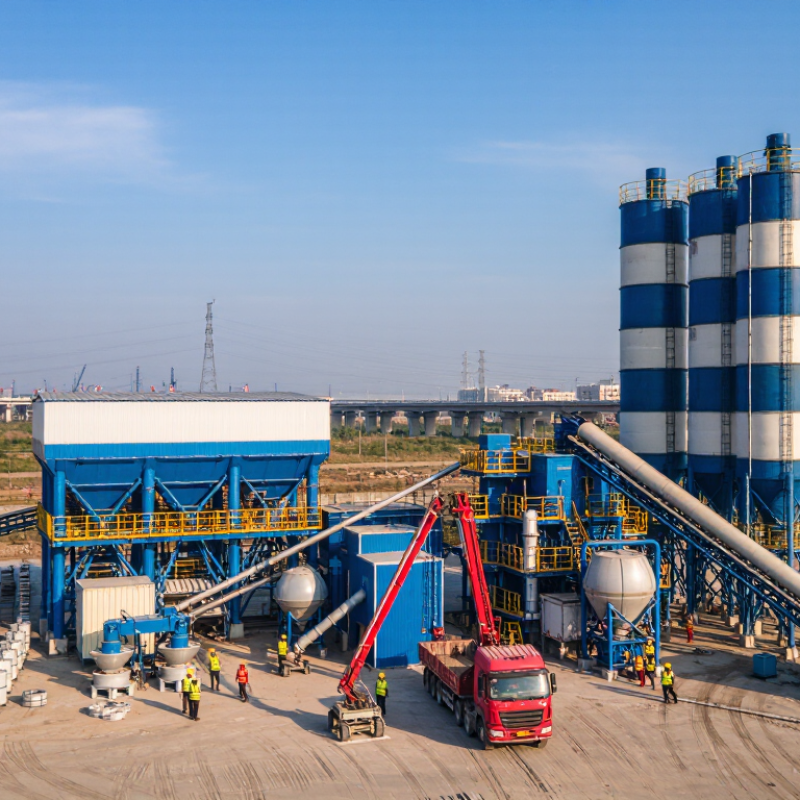
Concrete Batching Plants for Efficient Large-Scale Production
For global buyers, concrete batching plants support consistent production across roads, bridges, ports, and high-rise projects. A well-configured plant meters cement, aggregates, water, and admixtures with controlled accuracy. According to the Global Cement and Concrete Association, the built environment consumes about 14 billion cubic metres of concrete annually. This scale demands dependable feeding systems, rapid recipe changes, and stable output during long shifts. Twin-shaft mixers often suit demanding structural work because they promote intensive blending. Mobile plants can reduce setup time on remote construction sites. Fixed plants usually provide stronger capacity for continuous, large-scale production.
Site experience matters.
Moisture sensors can adjust water content when sand arrives wet after rainfall. This small correction protects slump and reduces rejected batches. The International Energy Agency reports that cement production creates roughly 7% of global energy-related and process CO2 emissions. Better batching cannot solve that entire problem, but accurate dosing can reduce material waste and unnecessary remixes.
Buyers should examine verified production tests, calibration records, spare-parts access, and local technician training. Rated capacity can also mislead. Real output falls when aggregate grading changes, trucks queue, or operators clean the mixer. A plant rated at 120 cubic metres per hour may deliver less in ordinary conditions. Asking for measured performance under comparable site conditions is more reliable than trusting brochure figures.
Mobile Concrete Plants for Flexible Project Deployment
Mobile concrete plants help contractors produce fresh concrete close to changing work zones. Their modular frames can travel by truck and set up near roads, bridges, ports, or remote foundations. This reduces long delivery routes and gives project teams more control over placing time. Space matters. A level surface, reliable power, clean water, and safe vehicle access remain essential.
Experienced operators inspect mixers, conveyors, control panels, and weighing systems before production. Accurate aggregate scales support consistent batches, while moisture checks help adjust water content. Operators should record cement quantities, mixing times, slump results, and batch temperatures. These records support quality decisions and help identify problems early. Local construction standards still govern every mix design and installation. A mobile plant does not remove that responsibility.
Flexible deployment can lower logistical pressure, but it is not effortless. Transport permits, foundation preparation, dust control, and trained maintenance staff require planning. Weather can also affect aggregate moisture and concrete performance. Measure twice. Small calibration errors may spread across hundreds of batches. In practice, the best setup balances production speed with inspection discipline. Teams should review delivery distances, expected output, site access, and future relocation needs before selecting equipment. A smaller plant may suit short projects, while larger systems can support steady structural work. Neither option is automatically better.
Typical Mobile Concrete Plant Options for Global Project Deployment
The chart compares representative rated production capacities commonly specified for compact, standard, and high-capacity mobile concrete plants. Compact units support remote or small-scale works, while larger configurations provide higher output for infrastructure and commercial projects with changing site requirements.
Concrete Block and Paver Machines for Construction Manufacturing
What Are the Top Betonway Products for Global Buyers?
Concrete Block and Paver Machines for Construction Manufacturing
Global buyers often compare concrete block and paver machines by output, automation, and serviceability. In practical production, these factors must match local demand. A compact block machine may suit small contractors and regional suppliers. High-capacity automatic systems fit large projects with steady orders. Buyers should inspect cycle time, mold-changing speed, vibration quality, and compatible block sizes.
Paver machines deserve close attention because surface appearance affects customer trust. Consistent vibration helps reduce air pockets and uneven edges. A reliable hydraulic system supports stable pressing pressure during long shifts. The machine should also handle local aggregates, including sand with different moisture levels. This detail is easy to overlook. It can affect strength and production speed.
Production lines usually need a pan mixer, conveyors, molds, pallets, and curing areas. Good equipment design makes cleaning and daily inspection easier. Operators should receive practical training before full production begins. Check emergency controls, spare-part availability, electrical compatibility, and technical documentation. Local construction standards must guide product testing and quality control.
Small mistakes happen. A slightly wet mix can damage paver edges. Poor pallet alignment can stop an otherwise capable line. I would not promise perfect output from any machine without trial production. Buyers should request sample blocks, review test records, and calculate maintenance costs. A realistic factory plan often matters more than the highest advertised capacity.
How to Select the Right Betonway Product for Your Market
Global buyers often compare concrete mixers, batching systems, pumps, molds, and related site equipment. The best choice depends on local construction conditions, not just the catalog price. A compact mixer may suit urban projects with narrow access. A stationary batching plant can support larger roads, bridges, and housing developments. Match output capacity with actual demand. Oversized equipment may increase idle time, fuel use, and maintenance costs.
Study your market before selecting a product. Check local power standards, available fuel, transport limits, and climate conditions. In hot regions, concrete can lose workability quickly, so accurate dosing and efficient delivery matter. In cold areas, insulation and reliable starting systems deserve closer attention. Ask whether replacement parts are available nearby. A low purchase price means little if one worn belt stops production for ten days.
Verify performance through technical documents, test records, and references from similar projects. Look for clear information about output, tolerances, noise, safety features, and cleaning requirements. Local operators should understand the controls without lengthy retraining. After-sales support also needs practical detail, including response times and remote troubleshooting. Specifications can look impressive on paper. They may not reflect muddy sites, unstable electricity, or inexperienced crews. A small pilot order or site trial can reveal problems that brochures often miss.
 Skip to content